
Climate Governance in Aviation: Why Technology Without Institutions Fails
- Cliff C. Belfor

- 7 days ago
- 3 min read
By InterConsult Advisors
Executive Insight
Sustainable Aviation Fuel (SAF), Artificial Intelligence (AI), and climate dashboards are rapidly reshaping the aviation sustainability discourse. Yet across regions, from Small Island Developing States (SIDS) to emerging aviation markets, the same pattern persists technology advances faster than governance capacity.
“The result is stalled climate projects, inaccessible finance, and underperforming climate outcomes.”
This paper argues a simple but often overlooked truth: climate ambition in aviation collapses without institutional readiness.

The Global Blind Spot in Aviation Climate Action
Over the past decade, aviation climate policy has focused heavily on technical solutions:
SAF production and blending mandates
AI-driven efficiency gains and predictive maintenance
Carbon monitoring tools and climate dashboards
Market-based measures and emissions accounting
While essential, these solutions often presume functional governance systems already exist. In reality, many national and regional aviation authorities operate under:
Fragmented mandates
Weak regulatory frameworks
Limited technical and policy capacity
Misalignment between aviation, climate, and finance institutions
Climate-focused aviation projects frequently fail not because the technology is unproven, but because the institutional architecture required to govern it is missing.
Technology vs. Institutional Readiness: A Structural Mismatch
SAF Without Policy Coherence
Sustainable Aviation Fuel is widely recognized as aviation’s most viable near- and mid-term decarbonization pathway. Yet deploying SAF at scale requires:
Clear national aviation climate strategies
Fuel certification frameworks
Blending mandates or incentive mechanisms
Cross-ministerial alignment (transport, energy, environment, finance)
In many jurisdictions, SAF initiatives are introduced before such frameworks exist. The result is policy uncertainty, investor hesitation, and stalled projects, especially in developing regions seeking access to international climate finance.
“Technology readiness does not equal governance readiness.”
2. AI and Climate Dashboards Without Decision Authority
AI-enabled tools and climate dashboards now promise real-time emissions tracking, performance benchmarking, and climate risk insights. However, these tools often fail to influence outcomes because:
No legal mandate defines how data informs decisions
Oversight authorities lack authority or competence to act on insights
Data governance frameworks are absent or unclear
Institutional silos prevent integrated decision-making
“Dashboards without governance become informational artifacts, not policy instruments.”
3. Climate Finance in Aviation: The Missing Prerequisites
Climate funds and development finance institutions consistently emphasize “readiness”, yet aviation projects often underperform on this criterion.
What Climate Financiers Actually Look For
Beyond emissions reduction potential, climate funds assess:
Institutional roles and responsibilities
Regulatory clarity and legal authority
Long-term policy stability
Monitoring, reporting, and verification (MRV) capacity
Safeguards and accountability mechanisms
“Aviation proposals focused primarily on hardware, fuels, or software frequently fail these tests. Climate finance is governed capital, not technology capital.”
Aviation’s Particular Governance Challenge
Unlike sectors such as energy or water, aviation climate action sits at the intersection of:
International obligations
National sovereignty
Regional airspace governance
Commercial airline operations
Public infrastructure oversight
Without deliberate governance design, climate investments in aviation face higher perceived risk, limiting access to concessional finance and blended capital.
Governance Risks in Climate-Driven Aviation Projects
When governance is treated as secondary, several risks emerge:
Regulatory Risk: Unclear or outdated aviation regulations can invalidate climate investments, delay certification, or expose governments to legal disputes.
Institutional Capture: Without transparency and accountability frameworks, climate-driven aviation projects risk is captured by narrow commercial or political interests, undermining public trust and donor confidence.
Fragmentation Risk: Disjointed responsibilities between civil aviation authorities, airport operators, climate agencies, and ministries result in duplication, delays, and cost overruns.
Sustainability Risk: Projects launched without embedded institutional capacity often collapse once external funding or technical assistance ends.
A Governance-First Framework for Aviation Climate Action
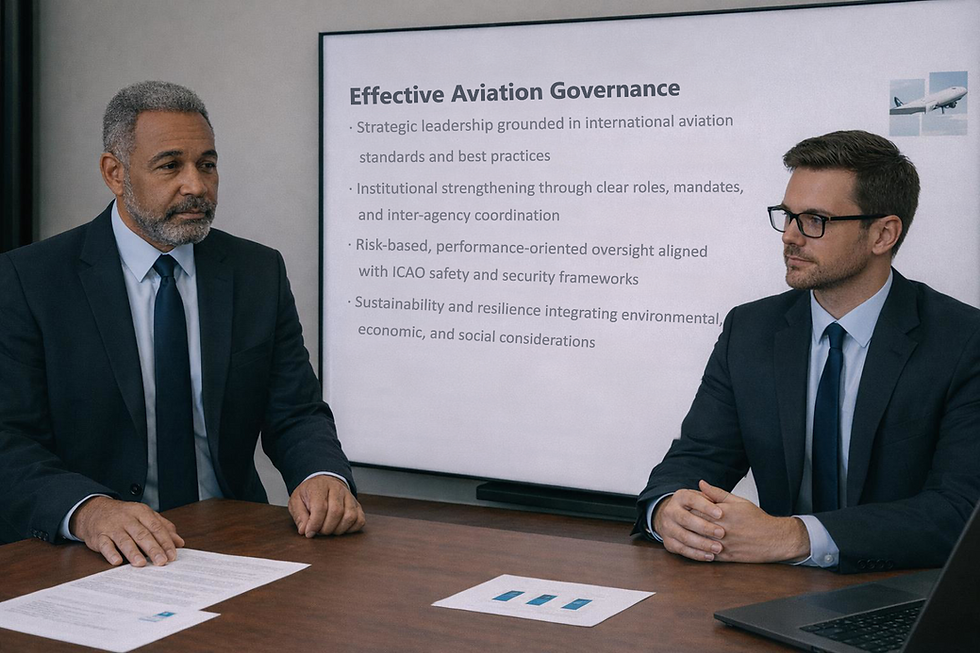
InterConsult Advisors advocates a governance-first approach to aviation decarbonization, one aligned with:
ICAO institutional oversight and safety frameworks
UNDP capacity development and climate governance principles
CARICOM regional integration and harmonization goals
EU regulatory alignment and climate finance standards
Core Governance Pillars
Institutional Mandate Clarity: Align aviation climate responsibilities across ministries and authorities.
Regulatory Readiness: Update legal frameworks to enable SAF, AI-driven oversight, and climate reporting.
Policy–Finance Integration: Design aviation climate strategies that directly meet climate fund eligibility criteria.
Capacity Embeddedness: Prioritize knowledge transfer and institutional learning, not one-off technical fixes.
Regional Cooperation: Treat aviation climate governance as a regional public good, especially in small markets.
Why This Matters for Global and Regional Stakeholders
For UN agencies and development partners, governance-first aviation strategies improve project bankability and sustainability.
For climate funds, they reduce fiduciary, regulatory, and operational risk.
For transport ministries, they enable compliance with international aviation and climate obligations while protecting national interests.
For regional organizations, they unlock economies of scale and regulatory harmonization.
Conclusion: Institutions Are the Climate Infrastructure
In aviation, institutions are as critical as fuels, data, and algorithms. Climate ambition without governance capacity does not scale, does not attract finance, and does not endure.
InterConsult Advisors positions governance not as an administrative afterthought, but as the enabling infrastructure of aviation decarbonization, bridging technology, finance, and policy.
"The future of climate-smart aviation will not be decided by who deploys the most advanced technology first, but by who governs it best.”


Comments